 HeadTidy
How to make a mind map
A mind map is just a picture of how ideas connect. The method below takes about ten minutes and works on paper or on a screen.
Written by Rene Reede Updated 17 August 2026
1. Start with one thing in the middle
Put the subject in the centre and give it a short name. Not "Q3 planning and hiring and the website", just "Q3". A centre that tries to be three things produces a map that is three maps fighting for room.
2. Add four to seven main branches
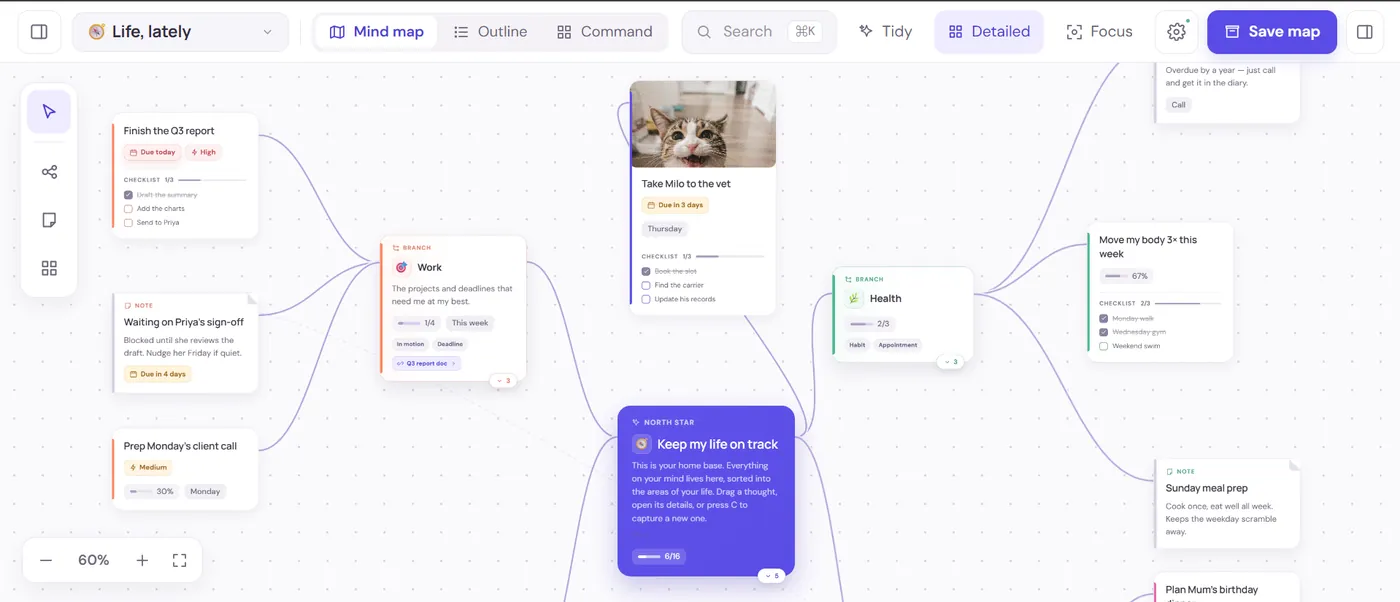
These are the big areas, and they are the most important decision you make. If you can name them badly you will feel it immediately: things stop having an obvious home. For a life map, branches like Work, Health, Money and People do most of the job. For a project, try Scope, Risks, People and Deadlines.
Keep branch labels to one or two words. Long labels are usually a sentence that wants to be a thought further down the tree.
3. Hang details off the branches
Work outward. Each new idea attaches to whichever branch it belongs under. Do not worry about the order or the wording yet. The point of this stage is to empty your head, not to be tidy.
4. Only now, look for connections
Some ideas relate to something on a completely different branch. Those cross links are usually where the interesting thinking is: the hiring problem that is really a budget problem, the health goal that depends on the work schedule. Mark them, but keep them visually quieter than the main structure.
5. Cut it back
A map you cannot read at a glance has failed at the one job it had. Collapse branches you are not working on, delete duplicates, and merge the two thoughts that turned out to be the same thought.
Four mistakes that make maps unusable
- Sentences instead of keywords. A branch that reads like a paragraph is a note, not a structure. Put the detail inside the thought, not on the label.
- Colour that means nothing. If everything is colourful, colour has stopped carrying information. Pick one thing for colour to mean, usually which area of life or work something belongs to, and leave the rest neutral.
- Ten main branches. Beyond about seven, you cannot hold the shape in your head, which was the entire point.
- Never revisiting it. A map made once and abandoned is a diagram. A map you return to weekly becomes a way of thinking.
Paper or software?
Paper is faster for a first pass and better for thinking, because nothing gets in the way. Software wins the moment you need to rearrange, search, collapse, link across branches or come back to it next month on a different device. Many people sketch on paper, then rebuild the version they intend to keep.
Frequently asked questions
How many branches should a mind map have?
Four to seven. Beyond about seven you can no longer hold the shape in your head, which was the reason for drawing it rather than listing it.
Should I use paper or an app?
Paper is faster for a first pass and better for thinking, because nothing gets in the way. Software wins the moment you need to rearrange, search, collapse, or come back next month on a different device.
What makes a mind map unreadable?
Sentences instead of keywords, colour that carries no meaning, more than about seven main branches, and never returning to it. Any one of those turns a map into decoration.