 HeadTidy
Mind mapping for ADHD and restless attention
A list assumes you will come back to it in order. If your attention does not work that way, the list is not a plan, it is a record of everything you have failed to do, sorted by age.
Written by Rene Reede Updated 7 September 2026
This is a practical article about organising work visually, written from experience of building a tool for it. It is not medical advice and it is not a treatment for anything. If attention difficulties are seriously affecting your life, that is a conversation worth having with a doctor.
Why the list keeps losing
A to-do list has three properties that work against a restless head. It is ordered, so you have to hold the order in mind. It is uniform, so a two-minute task and a two-month project look identical. And it is cumulative, so everything you did not do is still visible, which quietly turns the tool into a source of dread rather than a source of direction.
A map inverts all three. It is spatial, so you navigate by where things are rather than by remembering. It is uneven on purpose, so a project looks like a branch and a small task looks like a card. And it folds, so the part you are not working on can be out of sight without being gone.
The method
- Dump first, with no structure at all
Open the Brain dump template, or just press C and type. Everything goes to the Inbox: you are not deciding where anything belongs yet, because that decision is what stops people mid-thought. If typing is too slow for the pace of it, use voice capture and talk. The brain dump method is the longer version.
- Only then, sort into four or five areas
Money, Home, Work, People, Health is a fine starting set. Drag Inbox thoughts onto branches. You are looking for the smallest number of areas that covers everything, not the truest taxonomy.
- Put one North Star card in the middle
One sentence about what actually matters at the moment. It is there so that when you open the map with no idea why you opened it, something tells you.
- Date only what is genuinely dated
Resist dating everything. A date on a thing with no real deadline is a lie you will learn to ignore, and once you ignore one date you ignore all of them. Real deadlines get a date and an optional time; the rest just sits on the map.
- Break the one you keep avoiding into a checklist
Avoidance is almost always a sign that a card is really five cards and you cannot see the first one. Put the checklist inside the card so the map does not fill up with fragments. The card shows 0/5 on the canvas, and getting to 1/5 is usually the whole battle.
- Make the recurring things recur
Bins, medication, rent, the weekly shop. Set a repeat, daily, weekdays, weekly, fortnightly, monthly, quarterly or yearly, and ticking it off lines up the next one automatically. Anything that recurs and is not automated is a thing you are paying attention tax on every single week.
- Then stop using the map day to day
This is the part people miss. Once it is built, open Today. It reads across every map you have and shows only what is due, which is the shortest possible answer to "what now", and the map is still there underneath when you want the whole picture back.
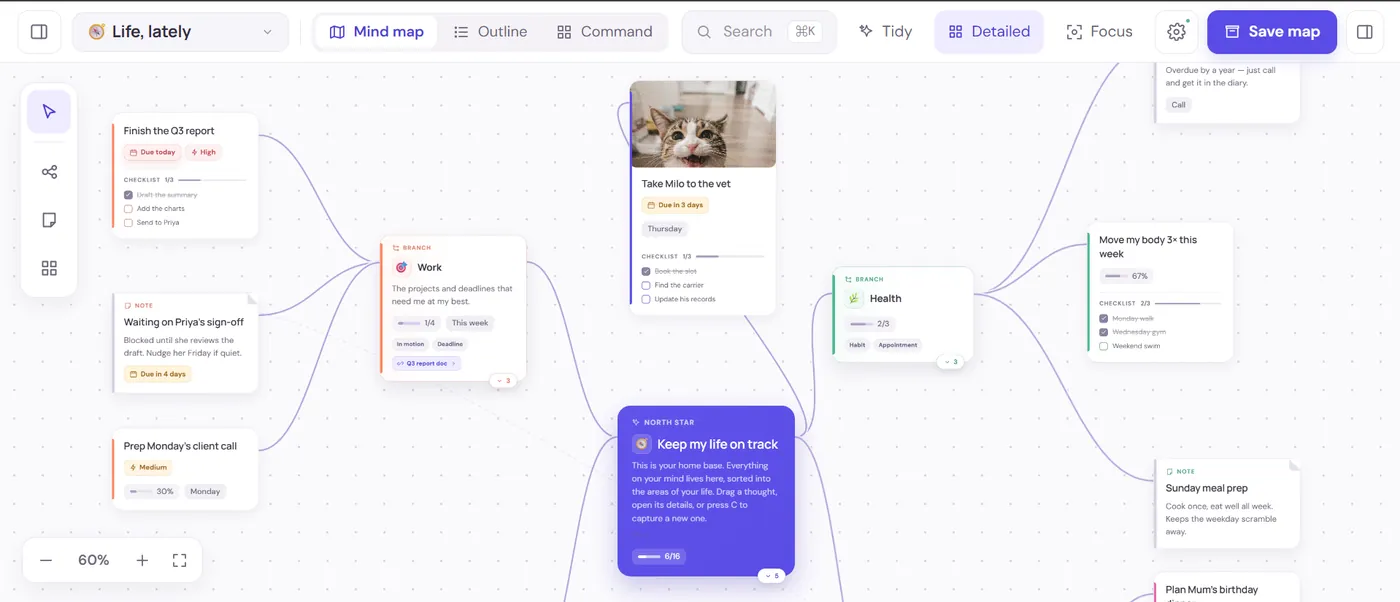
A map called Life, lately. Centre: Get through the move without dropping anything important. Five branches.
Money holds a table with columns for what, amount, due and paid; the amount column is a currency type, so the footer sums it and you can see the number you have been avoiding. Home holds Book the van (Friday, high priority) and Address changes (one card, seven-item checklist). Health holds two habits on weekday schedules, pausable, because the week you are ill should not cost you a streak. Work is a portal to its own map, so it is one card here instead of forty.
On a bad morning you do not open the map. You open Today, and it says: van, and one address change. That is a day you can start.
Four things that make it worse
Keep doing
- Capturing badly and fast, then sorting later.
- Folding branches you are not working on.
- Dating only what is really dated.
- Letting the map be ugly.
Stop doing
- Building a beautiful system instead of doing the work: the system is the most enjoyable form of procrastination ever invented.
- Making a branch for everything, until the map needs a map.
- Colour-coding by a scheme you will not remember next week.
- Starting a fresh map every time the old one gets messy.
Why a streak counter is the wrong measure
Most habit tools reward consecutive days, which means the first time life interrupts you, the tool tells you that you have failed and resets to zero. For anyone whose consistency is naturally uneven, that is a machine for producing shame on a schedule.
HeadTidy keeps the check-in history on the card and lets a habit be paused without losing it, so a fortnight off reads as a fortnight off rather than as starting again. Nine days out of fourteen is a good result. A tool that cannot represent nine out of fourteen is not measuring the thing you care about. There is more on this in habit tracking that lasts.
Getting your work back out
Worth checking before you commit to any tool: what happens when you want to leave, and what happens when you make a mistake. HeadTidy exports every map as JSON, Markdown, OPML, PNG or A3-paginated PDF. The JSON re-imports losslessly; the OPML opens in most other mapping tools, so moving on does not mean retyping.
Inside the app the Vault holds 50 steps of undo and redo, twelve recoverable checkpoints per map, and a Trash that keeps deleted maps and thoughts. Maps live in the browser first and sync when you are online, with the saving, offline and conflict states always visible rather than hidden behind a spinner. Read more about private sharing, recovery and exports.
Frequently asked questions
Why do mind maps work better than to-do lists for some people?
A list is ordered, uniform and cumulative: you have to hold the order in mind, every item looks the same size, and everything undone stays visible. A map is spatial so you navigate by position rather than memory, it is deliberately uneven so a project looks different from a two-minute task, and branches fold so the part you are not working on can be out of sight without being lost.
How do I stop the map itself becoming another abandoned system?
Build it once and then mostly stop opening it. Use Quick Capture to get thoughts in, and use the Today view day to day: it reads across every map and shows only what is due. The map is for the weekly look at the whole picture, not for daily use.
What should I do about the task I keep avoiding?
Avoidance usually means the card is really five cards and you cannot see the first one. Open it, add a checklist inside the card, and make the first item embarrassingly small. The card then shows 0/5 on the canvas, and moving it to 1/5 is normally the entire difficulty.
Are streaks a good way to track habits?
Not for most people. A streak resets to zero the first time life interrupts you, which turns an ordinary week into a failure. HeadTidy keeps the check-in history on the card and lets a habit be paused without losing it, so nine days out of fourteen reads as nine days out of fourteen.
Is HeadTidy free?
Yes. The free plan covers 3 maps and 300 thoughts with no card required, and it is a plan rather than a trial, nothing expires. Pro is €5 a month or €48 a year.