 HeadTidy
A calmer Miro alternative for personal use
Miro is an infinite whiteboard built so a room full of people can work on one surface. HeadTidy is a free, quieter alternative for one person who wants to keep a visual map useful, and then act on it.
Written by Rene Reede Updated 30 August 2026
Everything here describes what each tool is built for, not what it costs. Pricing and plan limits change often, so check the vendor's own page for current figures, and note that HeadTidy is made by one person, not a company with a sales team.
The structural difference
Miro is a surface. It will hold anything you put on it: stickies, frames, diagrams, screenshots, embedded documents, a whole workshop. That freedom is exactly what makes it good for facilitation and exactly what makes a solo board go stale, nothing on a Miro board knows it is due on Thursday, so the board records your thinking and then sits there.
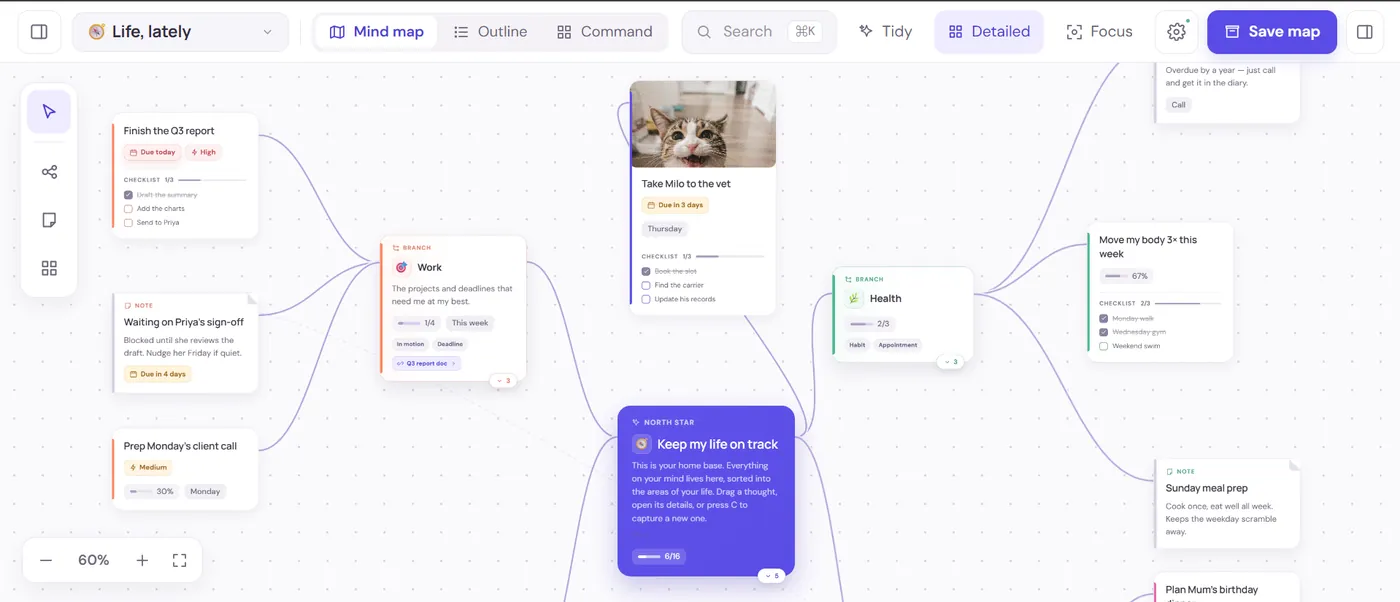
HeadTidy narrows the surface deliberately. A canvas holds one map, thoughts connect to a centre, and every thought can carry the follow-through: a date, a repeat, an owner, a priority, a checklist, a habit schedule. The result is a map you reopen because it still has something to tell you, rather than a picture of a meeting you had in March.
The second difference is weight. Miro is a large collaborative application; HeadTidy is small enough to keep working with the connection off, and stores your maps in the browser first.
What sits on the canvas in HeadTidy
The reason a personal map turns into action here is that a thought is not only a label. Any card can carry the following, and none of it lives in a second app:
- A due date, an optional time and a repeat
Daily, weekdays, weekly, fortnightly, monthly, quarterly or yearly. Ticking a repeating card off lines up the next occurrence rather than just marking it done, so "water the plants" and "file the quarterly return" both stop needing a separate list.
- A checklist inside the card
Sub-steps stay folded into the thought they belong to instead of exploding your map into twenty tiny nodes. The card shows progress as 2/5 on the canvas.
- A live table, right on the map
Typed columns, text, number, currency, date, person, checkbox, status, priority, with sum, average, count, min and max in the footer. Filter, sort, group and hide-done are built in, you can paste a block straight from a spreadsheet, and any row can be promoted to a connected task card.
- A habit with a schedule
Check-ins land on the card itself, and it can be paused without losing the history, which matters more than a streak counter, because streaks punish the week you were ill.
- Notes, images and a sketch pad
Drop a photo on any thought. Notes open a small drawing surface with five inks, three pen sizes, an eraser and its own undo, saved through the same pipeline as an attachment.
- A portal to another map
When a branch outgrows its map, it becomes a doorway to its own canvas instead of a mess. Search still reaches into it.
Five ways to read the same maps
Capturing visually and reviewing visually are different jobs, and most mapping tools only do the first. The same thoughts render as:
- Map, the canvas, for shape and relationships.
- List, the same thoughts flattened, for when you just want to work through them.
- Today, everything due now across every map, not just the one you have open, with week, month and timeline ranges.
- Calendar, dated thoughts on a real calendar.
- Outline, the map as indented text, which is also how it exports to Markdown.
And Ctrl/⌘+K searches across every map at once, by thought, person, owner, due window, map or folder, so nothing is lost just because you cannot remember which canvas you put it on.
Side by side
| Job | HeadTidy | Miro |
|---|---|---|
| Live workshop with many cursors | Private share links with view or edit roles and comments | Built for exactly this: timers, voting, facilitation |
| Dates and repeats on the thought | Built in, plus Today and Calendar views across all maps | Needs an integration or a separate tracker |
| Free surface for anything | Deliberately narrower: one map per canvas | Genuinely unlimited canvas |
| Works with no connection | Offline-first, with sync state always visible | Cloud-first |
| Templates | A focused starter library for thinking, planning, life and work | A very large public template library |
| Export and leave | JSON, Markdown, OPML, PNG, PDF | Board export formats vary by plan |
Say you are moving flat. In Miro you would make a frame called Move, fill it with stickies, broadband, deposit, van, address changes, boxes, and cluster them. It looks right. Nothing happens.
In HeadTidy the same capture goes into a Move branch, then: Book van gets Friday and high priority; Address changes becomes a card with a five-item checklist so it does not sprawl; Deposit gets a table with a currency column so the footer sums what you are owed; Broadband gets a note and a photo of the router label. On Monday, Today shows you the van booking and nothing else, because the other eleven things are not due yet, and they are still on the map when they are. There is a moving home template that starts you there.
HeadTidy works when
- The board is yours and needs to survive contact with next week.
- You want dates, habits, checklists and tables on the same canvas as the ideas.
- You want it to keep working on a train.
- You would rather pay one small price than per seat.
It does not when
- Several people need simultaneous cursors on one surface.
- You are facilitating: timers, voting, breakouts, retro formats.
- You need a genuinely freeform canvas, not a map with a centre.
- Your organisation requires SSO and admin controls.
Getting your work back out
Worth checking before you commit to any tool: what happens when you want to leave, and what happens when you make a mistake. HeadTidy exports every map as JSON, Markdown, OPML, PNG or A3-paginated PDF. The JSON re-imports losslessly; the OPML opens in most other mapping tools, so moving on does not mean retyping.
Inside the app the Vault holds 50 steps of undo and redo, twelve recoverable checkpoints per map, and a Trash that keeps deleted maps and thoughts. Maps live in the browser first and sync when you are online, with the saving, offline and conflict states always visible rather than hidden behind a spinner. Read more about private sharing, recovery and exports.
Frequently asked questions
Is HeadTidy free?
Yes. The free plan covers 3 maps and 300 thoughts with no card required, and it is a plan rather than a trial, nothing expires. Pro is €5 a month or €48 a year.
Can HeadTidy replace Miro for team work?
Not for live facilitation. HeadTidy has private share links with view or edit roles and comments, which covers showing a map to someone and getting their notes back, but it does not do simultaneous multiplayer cursors, timers or voting. If your main use is running workshops, stay on Miro.
Can I move a Miro board into HeadTidy?
Not directly. HeadTidy imports its own JSON. A sticky-note board usually rebuilds faster than you expect, and rebuilding is a decent moment to drop the two thirds of it that stopped mattering.
Does HeadTidy work offline?
Yes. Your maps live in the browser first and sync when you are online, with saving, offline and conflict states always visible.